Everyone wants AI. Everyone wants automation.
Information access no longer happens at human scale.
Information is no longer read. It is constantly requested.
Human governance doesn’t scale to machine demand.
Every request is computed. Every disclosure is governed. Every transaction is provable.
the decision layer
LIVE · 5 outcomes computed
ALLOWPARTIALREDACTTIME-LIMITEDREVOKEDENY
Millions of requests can’t be governed by hand.
CTO · AI teams
“AI can’t reach the information it needs.”
CISO
“We can’t allow unrestricted access to information.”
COO
“Every process waits for someone to approve access.”
Partners
“Connecting organizations creates risk.”
One engine behind all four. Start where you are.
For security & compliance
Just Prove It.
Verifiable evidence for every AI decision: who saw what, under which policy, checkable without us.
For developers
See what your agent saw.
Paste a trace, see exactly what it was exposed to. Runs in your browser, no signup.
NoData in ten promises — govern plaintext, keep control, and prove every disclosure.
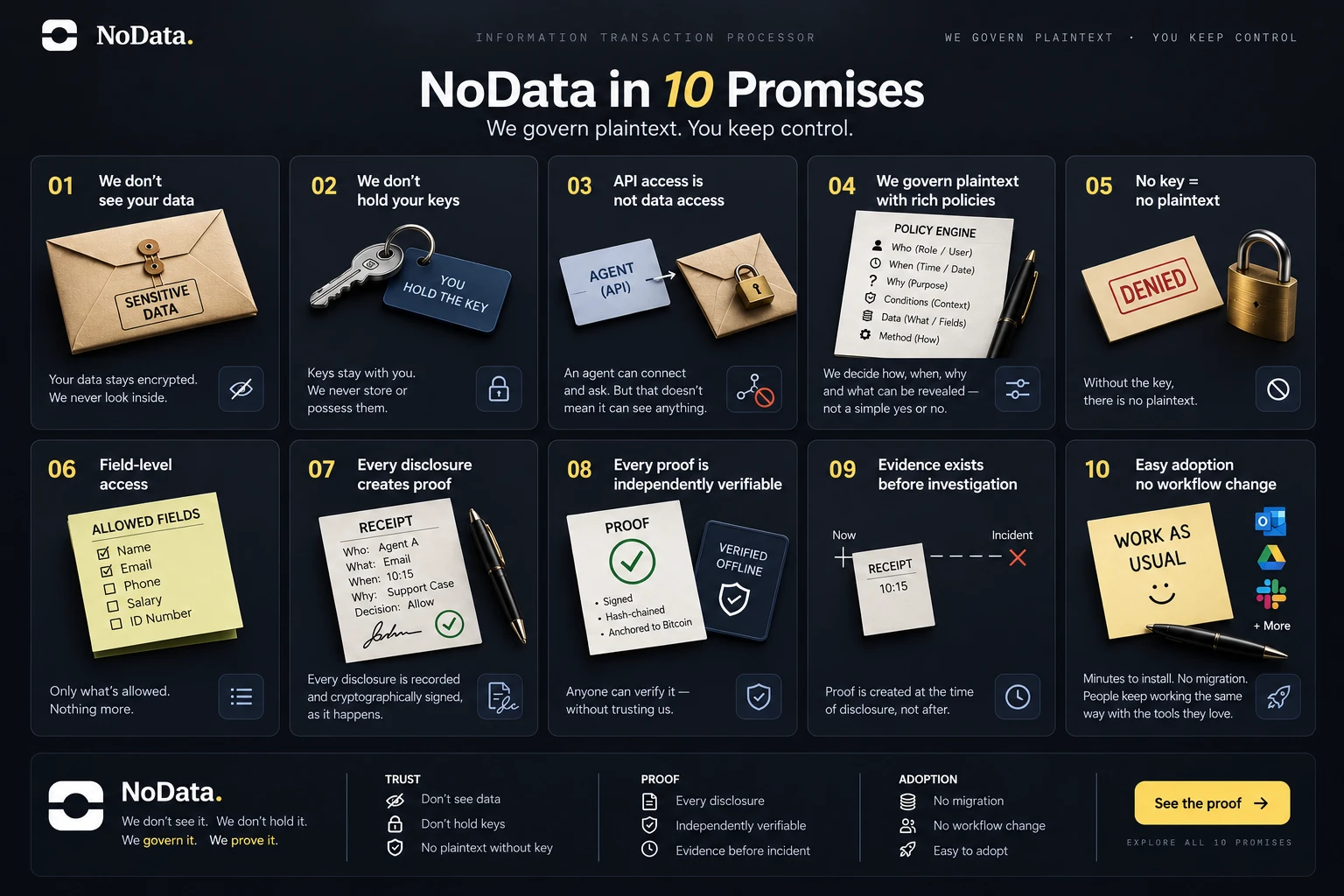
Ten promises.Every one backed by code, policy, keys, and proof.
Free · in your browser · no signup
See what your AI can already see.
Paste a trace, scan a folder, or drop an export — it all runs in your browser. Nothing leaves.
The ProblemEverything guards the container.
Everything guards the container.
Nothing governs the use.
Guarded
✓ Files ✓ Apps ✓ Devices ✓ Identity
✓ Files ✓ Apps ✓ Devices ✓ Identity
Ungoverned
✗ The moment information is used.
✗ The moment information is used.
AI changed the scale.
100,000 requests don’t create 100,000 investigations.
They require 100,000 decisions.
They require 100,000 decisions.
The Model
An information transaction: one request, one decision, one proof.
Subject→Asset→Context→Purpose→Policy→Decision→Proof→Verification
Millions of attempts. Millions of outcomes.
NoData computes, enforces and proves information transactions. The processor computes policy. No proof, no release.
Verification is performed by anyone, without NoData.
Proof, not trustVerify a proof by its serial →
Cryptographic proof on every transaction. Not logs.
Control without custody.
Proof without trust.
Verification without NoData.
212
Subjects
48,321
Assets
127
Policies
19,542
Decisions
19,542
Evidence Records
One API Call
Like Stripe turned payments into an API, NoData turns information governance into an API.
A single transaction.A policy decision.A cryptographic proof.
const decision = await nodata.authorize({
  subject: "agent://analyst",
  asset:   "finance/forecasts",
  action:  "read"
})

console.log(decision.verdict)
// allow
console.log(decision.receipt)
// cryptographic evidence
The same engine, five applications